Introduction
Whether you’re streaming a movie, making a video call, using cloud storage, or asking an AI assistant a question, there’s one thing working behind the scenes—a data center.
Data centers have become one of the fastest-growing sectors in the world, driven by cloud computing, artificial intelligence (AI), edge computing, and digital transformation. As organizations demand more computing power, the need for reliable, efficient, and intelligent facilities has never been greater.
But what exactly is a data center, and what do all the technical terms mean?
This guide explains the most important data center concepts and terminology, helping you better understand the critical infrastructure that keeps the digital economy running.
What is a Data Center?
A data center is a highly engineered facility that houses computing equipment used to process, store, and distribute digital information.
Inside a data center you’ll typically find:
- Servers
- Storage systems
- Network switches and routers
- Electrical distribution equipment
- UPS systems
- Backup generators
- Cooling equipment
- Fire protection systems
- Physical security systems
- Building automation systems
Unlike a traditional office building, data centers are designed to operate 24 hours a day, 365 days a year, often with little or no downtime.
Server
A server is a specialized computer that provides services, applications, or data to users and other computers across a network.
Examples include:
- Web servers
- Database servers
- File servers
- AI compute servers
- Virtualization hosts
Thousands of servers may operate inside a single facility.
Rack
Servers are mounted inside standardized equipment racks, typically measuring 42U, 48U, or 52U in height.
Each rack contains:
- Servers
- Network switches
- Power Distribution Units (PDUs)
- Cable management
- Environmental sensors
Large hyperscale facilities can contain tens of thousands of racks.
White Space
The white space is the area where IT equipment is installed.
This includes:
- Server rows
- Network cabinets
- Storage equipment
- Hot and cold aisles
Everything supporting the white space exists to keep this equipment operating continuously.
UPS (Uninterruptible Power Supply)
The UPS provides instant backup power whenever utility power is interrupted.
Its primary job is to bridge the gap between:
Utility Power → Generator Startup
Without a UPS, servers would immediately lose power during an outage.
Modern UPS systems also:
- Condition incoming power
- Filter electrical disturbances
- Improve power quality
Generator
Backup generators provide long-duration emergency power during utility outages.
Most large data centers use:
- Diesel generators
- Natural gas generators
Generators typically start within seconds and can power an entire campus for days with adequate fuel.
ATS (Automatic Transfer Switch)
An ATS automatically transfers electrical loads between:
- Utility power
- Generator power
Operators rarely need to intervene because the transfer occurs automatically.
PDU (Power Distribution Unit)
Power Distribution Units distribute electrical power throughout the facility.
There are several types:
- Main distribution PDUs
- Remote Power Panels (RPP)
- Rack PDUs
Modern intelligent PDUs also monitor:
- Voltage
- Current
- Power
- Energy
- Branch circuit loading
Busway
Instead of running thousands of cables overhead, many modern facilities use busway systems.
Busways provide:
- Flexible power distribution
- Easier rack additions
- Reduced installation costs
- Improved scalability
Cooling Systems
Servers generate enormous amounts of heat.
Cooling systems maintain safe operating temperatures using:
- Chillers
- Cooling towers
- CRAH units
- CRAC units
- In-row cooling
- Rear door heat exchangers
- Liquid cooling
Cooling is often one of the largest energy consumers in a data center.
CRAH vs CRAC
CRAH (Computer Room Air Handler)
Uses chilled water supplied from a central chiller plant.
Advantages:
- Higher efficiency
- Lower operating costs
- Common in hyperscale facilities
CRAC (Computer Room Air Conditioner)
Contains its own refrigeration compressor.
Advantages:
- Self-contained
- Simpler installation
- Often used in smaller facilities
Hot Aisle / Cold Aisle
Servers draw cool air through the front and exhaust hot air from the rear.
By arranging racks correctly:
Cold Aisle → Cool intake air
Hot Aisle → Hot exhaust air
This simple design dramatically improves cooling efficiency.
Redundancy
Redundancy means having backup equipment available if something fails.
Common redundancy levels include:
- N
- N+1
- 2N
- 2N+1
Higher redundancy means greater uptime but also higher construction costs.
Tier Ratings
The Uptime Institute defines four common facility tiers.
Tier I
- Basic infrastructure
- Limited redundancy
Tier II
- Redundant components
- Improved reliability
Tier III
- Concurrently maintainable
- Maintenance without shutdown
Tier IV
- Fault tolerant
- Highest level of availability
- Typically 99.995% uptime
PUE (Power Usage Effectiveness)
PUE measures how efficiently a data center uses energy.
Formula:
PUE = Total Facility Power ÷ IT Equipment Power
Example:
Facility uses 2 MW
Servers use 1.5 MW
PUE = 1.33
Lower numbers are better.
Typical values:
- Older facilities: 2.0+
- Modern enterprise: 1.4–1.6
- Hyperscale: 1.10–1.25
BMS (Building Management System)
The Building Management System monitors and controls:
- HVAC
- Chillers
- Pumps
- Cooling towers
- Lighting
- Environmental systems
The BMS ensures the facility operates safely and efficiently.
EPMS (Electrical Power Monitoring System)
The EPMS focuses specifically on electrical infrastructure.
Typical monitored equipment includes:
- Switchgear
- UPS systems
- Generators
- Transformers
- PDUs
- Busways
- Breakers
Operators use EPMS to monitor electrical health and respond quickly to abnormal conditions.
SCADA (Supervisory Control and Data Acquisition)
SCADA provides centralized monitoring and visualization across the entire facility.
Typical SCADA dashboards display:
- Power flow
- Generator status
- UPS loading
- Cooling performance
- Environmental conditions
- Alarm management
- Historical trends
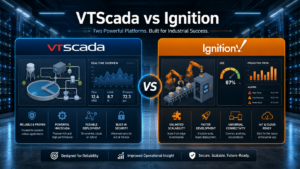
Modern platforms such as Ignition are becoming increasingly popular because they integrate data from BMS, EPMS, PLCs, intelligent meters, and IoT devices into a single operational dashboard.
DCIM (Data Center Infrastructure Management)
DCIM combines operational data with business intelligence.
Typical DCIM software tracks:
- Rack utilization
- Available capacity
- Asset inventory
- Power consumption
- Cooling efficiency
- Space planning
- Work orders
Think of DCIM as the management layer above SCADA.
Digital Twins
A digital twin is a virtual model of the physical data center.
Using live operational data, operators can:
- Simulate failures
- Test equipment changes
- Predict capacity constraints
- Optimize energy usage
Digital twins are becoming an important tool for AI-enabled facilities.
AI and Predictive Maintenance
Artificial Intelligence is helping operators move from reactive maintenance to predictive maintenance.
AI can identify:
- Bearing failures
- Cooling inefficiencies
- UPS battery degradation
- Generator health
- Power quality anomalies
This reduces downtime while lowering maintenance costs.
Why Automation Matters
Today’s data centers generate millions of data points every day.
Without automation, operators struggle to:
- Detect failures quickly
- Optimize energy usage
- Improve reliability
- Reduce operating costs
Modern automation platforms integrate:
- PLCs
- SCADA
- EPMS
- BMS
- MQTT
- IIoT
- Cloud analytics
to create a single source of truth for facility operations.
Final Thoughts
Data centers are no longer just buildings full of servers—they are highly sophisticated, mission-critical facilities that power nearly every aspect of modern life.
Understanding concepts such as UPS systems, PUE, SCADA, BMS, EPMS, redundancy, and DCIM helps organizations make better decisions when designing, operating, or modernizing their infrastructure.
As AI, cloud computing, and high-performance computing continue to grow, the demand for intelligent, efficient, and resilient data centers will only accelerate.
At IoTech Engineering, we specialize in helping data centers integrate automation, SCADA, EPMS, BMS, IIoT, and digital transformation technologies to improve uptime, efficiency, and operational visibility.
🌐 Website: https://DataCenterSCADA.com/
📞 Call Us: 864-824-4468
Whether you’re building a new facility or upgrading an existing one, we’re here to help you create the next generation of intelligent data center infrastructure.